Contents
Cover Story
Feature Articles
News
Snapshot
Editor's Notes
In this issue of Electricity News, we will continue to report the latest progress on the adoption of the new cable colour code for fixed electrical wiring in Hong Kong. The issues covered include the implementation schedule, a study of the cable supply, technical support, training, publicity, etc. A copy of the Installation Guidelines is also attached to this issue of Electricity News for trade members' reference. In addition, we will brief our readers on how to select cables of suitable sizes and safety tips for designing and installing advertising lightboxes. We will also report the establishment of the third underground cable detection training centre in Hong Kong, a well equipped venue for training more competent persons for underground cable detection.
We received valuable feedback about the last issue of Electricity News and we thank our readers for taking time to offer their views. In order to improve the newsletter and enrich its content, we again appeal to you to complete the feedback form on the back cover and return it to our Electricity Legislation Division as soon as possible.
Twins Express Thanks to Registered Electrical Contractors and Workers

Twins, the cover girls of this issue of Electricity News, is a popular local performing group formed by Charlene Choi and Gillian Chung. Formed in 2001, Twins soon became prominent singers and pop film and TV stars, and have gained much popularity among young music fans. In recent years, Twins have performed in many places including the Mainland, Hong Kong, Taiwan and overseas cities.
When asked if she knew about the electrical trade in Hong Kong, Charlene said, "Of the cities I frequently toured, Hong Kong has attained a high level of electrical safety. There are few power interruption incidents or serious electrical accidents in Hong Kong." Gillian said, "I share Charlene's view. For example, in preparing for the performances, we often have a number of electrical workers to install electrical installations at the venues. They are all well trained and professional. As far as I know, no electrical accidents have ever happened at the venues. So I have much confidence in the electrical workers of Hong Kong." Our reporter (an engineer from our Electricity Legislation Division) added, "A registration system for electrical contractors and workers is implemented in Hong Kong.The Electrical and Mechanical Services Department ("EMSD") is responsible for effectively monitoring their performance in designing, installing and testing electrical installations to ensure that the quality and safety of these installations meet the statutory requirements."
Charlene and Gillian asked our reporter, "We love to listen to music and watch movies at home in our leisure time. What are the safety standards of these audio-visual products?" Our reporter explained, "All electrical products which are designed for household use and supply in Hong Kong shall comply with the Electrical Products (Safety) Regulation to ensure household electrical safety. There is no need to worry if you use, maintain and repair these electrical products properly." Our reporter then gave Twins two copies of the colourful Household Electrical Safety Handbook published by the EMSD for their reference.
Through the brief interview with our reporter, Twins gained a better understanding of the electrical trade in Hong Kong. They would like to thank all registered electrical contractors ("RECs") and workers ("REWs") in Hong Kong for their services to the community.
Acknowledgement: Emperor Entertainment Group
An Update on the Adoption of the New Cable Colour Code
Following the report in the last issue of Electricity News, we will continue to update our readers on the adoption of the new cable colour code.
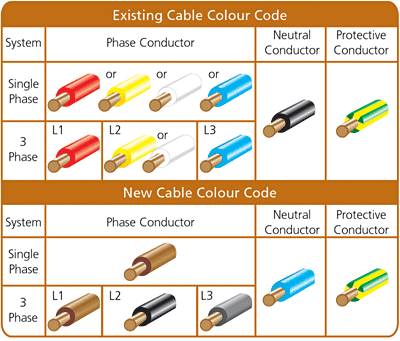
The existing cable colour code (i.e. red/ yellow/ blue/ black/ (yellow - green)) is to be replaced by the new cable colour code (i.e. brown/ black/ grey/ blue/ (yellow-green)). The new cable colour system will not only align with the standards adopted by most western countries but also harmonize the cable colours for flexible cords. As for the implementation schedule, the Electrical Safety Advisory Committee has agreed to the recommendation of the Working Group on the Review of Cable Colour Code in Hong Kong that the new cable colour code be applicable to new fixed electrical installations and additions or alterations to existing fixed electrical installations with effect from 1 July 2007. During a two-year grace period between 1 July 2007 and 30 June 2009, cables of both new and existing colours can be used. However, from 1 July 2009, the new cable colour code must be used for fixed electrical installations. The relevant change is applicable only to fixed electrical installations. Household electrical products will not be affected.
The evaluation report on cable supply points out that a substantial percentage of low voltage cables used in Hong Kong are imported from western countries. Since the UK and major European countries (members of the European Committee for Electrotechnical Standardisation) have adopted the new cable colour code, the supply and manufacture of cables in the old colour code will be inevitably affected. Although our current cable colour code is still being used by countries such as Singapore and Malaysia, it is expected that from April 2006 (when the new cable colour code becomes mandatory in the UK) some cable manufacturers will switch to manufacturing cables in the new colour code and avoid stocking old coloured cables not commonly needed by the market. As market demand for new coloured cables will grow substantially, manufacturers may opt for manufacturing new coloured cables. Therefore, contractors in Hong Kong will need to place special orders for certain types of old coloured cables in future if our cable colour code remains unchanged. According to the trade practice, a minimum order quantity (MOQ) with a longer delivery time will be required for manufacturing cables to special orders. It is expected that the MOQ and a longer delivery time will eventually have impact on the project costs and the commissioning dates for the Hong Kong industry. Moreover, the manufacture of cables is based on batch type production mode. If the old coloured cable market is shrinking, contractors in Hong Kong can choose only from a limited number of cable manufacturers for ordering old coloured cables. While cable manufacturers will still supply cables in the old colour code, it will be at a higher price as compared to those in the new colour code. As such, the use of the new cable colour code will ensure a stable supply of cables to Hong Kong, prevent possible price fluctuations, and avoid a long delivery time. Such advantages will benefit the trade and eventually the general public.
On the provision of technical support, we have prepared the Chinese and English versions of the Installation Guidelines for the trade. The guidelines cover the standards relating to the new cable colour code, the new colours and code used as well as their application, the implementation schedule, the technical requirements on the use of the new cable colour code in new and existing installations, the safety measures taken when working on energized installations, etc. For details, please refer to the Installation Guidelines attached to this issue of Electricity News. In addition, the technical requirements stated in the Installation Guidelines will be included as an annex in the Code of Practice for the Electricity (Wiring) Regulations.
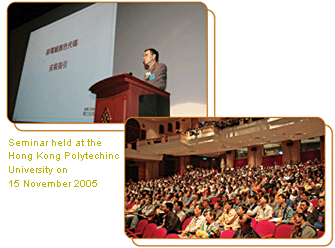
As far as training is concerned, we have conducted three mass-scale training sessions for about 3,000 REWs at the Hong Kong Polytechnic University and the Sha Tin Town Hall. In addition, we have arranged three train-the-trainers workshops to provide training for about 300 trainers working for RECs. These arrangements aim to give thorough training to REWs on the requirements in the implementation of the new cable colour code. As regards web-based self-learning training, a web-corner will be created in the EMSD web site and the self-learning materials will be uploaded to the web-corner in the second quarter of this year.
For publicity activities, we have devised a publicity plan and will publish a series of promotion materials such as leaflets, posters, pocket cards, articles in the newsletters, gazette notices, etc. These promotion materials will be distributed to the trade and the general public through various channels. We will announce the change through the annual technical seminars held for the trade, the Electricity News, the E & M Safety Newsletter, the mass media, the trade associations, educational institutions, management companies, government departments, etc. The update on the adoption of the new cable colour code and the relevant guidelines will also be uploaded to the new web-corner mentioned in the preceding paragraph.
Meanwhile, we will continue to maintain close contact with relevant institutions on the Mainland and from overseas about the new cable colour code and electrical safety issues. Information suggests that no electrical incidents resulting from the change have been reported in the UK since the transition began. To ensure electrical safety, we have been making reference to the UK's practice and criteria in devising the installation guidelines. Moreover, Singapore is now studying the issues on the change and is likely to adopt the new cable colour code (i.e. brown/ black/ grey/ blue/ (yellow-green)).
For updates on the adoption of the new cable colour code, please visit the EMSD homepage at www.emsd.gov.hk.
Select Cables of Suitable Sizes
Cables are essential components of electrical installations. Selecting suitable cables complying with relevant standards and safety requirements can ensure the safe operation of circuits and reduce electrical accidents causing loss of life and property. Certain knowledge is required in cable selection. Please refer to the Code of Practice for the Electricity (Wiring) Regulations for selecting cables of suitable sizes.
According to Code 13 of the Code of Practice for the Electricity (Wiring) Regulations, a conductor should have a current carrying capacity not less than the maximum current demand it normally carries, be capable of withstanding the prospective fault current, and suitable for operation in the environment and at the design voltage of the installation. We should consider the following factors and method when determining the sizes of cable conductors:
Factors to be considered in sizing of cable conductors
- the conductor material;
- the insulating material;
- the ambient temperature in which the cable is installed;
- the method of installation;
- whether or not the cable is affected by thermal insulating material;
- the use and type of protective device;
- the voltage drop from the origin of the circuit to the load; and
- for Category 1 circuits, live conductors should have a cross-sectional area:
- not less than 1.5 mm2 for surface wiring using PVC insulated PVC sheath copper cables;
- not less than 1.0 mm2 for single core PVC insulated copper cables installed in conduit, duct, ducting or trunking;
- not less than 16 mm2 for aluminium conductors;
- not less than 0.5 mm2 for flexible cables and flexible cords.
Method of sizing cable conductors
- Determine the design current of the circuit under consideration;
- Choose a suitable overcurrent protective device;
- Determine the current carrying capacity of the conductors required by applying suitable correction factors to the nominal setting or current rating of the overcurrent protective device as divisors (typical correction factors for ambient temperature, grouping, thermal insulation and type of protective device);
- Choose suitable size of the conductors according to the current carrying capacity required;
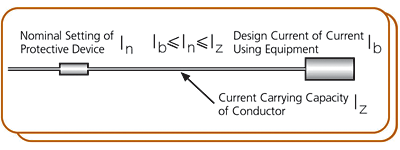
- The resulting voltage drop in the circuit should be checked so that under normal service conditions the voltage at the terminals of any fixed current using equipment should be greater than the lower limit corresponding to recognised standards relevant to the equipment.
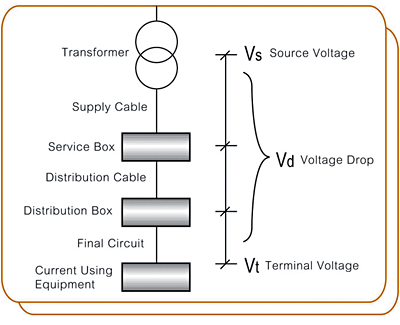
Refer to Tables A6 (1) to A6 (8) of the Code of Practice for the Electricity (Wiring) Regulations for the current carrying capacities and values of voltage drop.
Units denoting cable sizes
Regarding the testing standards and safety specifications of cables, BS 2004, drawn up many years ago, has been replaced by BS 6004. Currently, IEC 60227 and Chinese Standard GB 5023 have become widely adopted safety standards. The unit used in the above standards is square millimetre (mm news ). If you find cables still employing imperial units in the local market, you should be careful as they may not have been tested against the above safety standards and may not possess valid "certificates of safety compliance". According to the Electrical Products (Safety) Regulation under the Electricity Ordinance (Cap. 406), any person supplying cables which fail to comply with the applicable safety requirements or which do not possess certificates of safety compliance commits an offence and is liable to prosecution.
Experienced electrical workers may have concern over whether they can still use cables employing imperial units. In the past, cables employing imperial units that were widely used were called "7 x 22 SWG" (7/0.6 mm), "7 x 20 SWG" (7/0.8 mm), "7 x 18 SWG" (7/1.0 mm), "3 x 22 SWG" (3/0.6 mm) and "1 x 18 SWG" (1/1.0 mm) within the trade. According to the current legislation, suppliers should ensure that these cables have passed tests based on the new standards and been issued with "certificates of safety compliance" and that the cross-sectional areas are denoted by mm news before putting them on the market.
The Code of Practice for the Electricity (Wiring) Regulations provides information on the current carrying capacities and values of voltage drop of cables whose cross-sectional areas are denoted by mm news for the trade's reference. At present, wiring regulations to which the electrical trade usually refer are IEC Standards, Chinese Standards (GB), European Standards (EN) and British Standards (BS), all of which use metric units. Even in Britain, where the imperial units originated, the wiring regulation BS 7671 switched from imperial to metric units many years ago. From the legal and safety points of view, if contractors and workers who install cables employing imperial units fail to comply with the safety requirements for cross-sectional areas stipulated in the Electricity (Wiring) Regulations and Code of Practice for the Electricity (Wiring) Regulations due to unit conversion or other reasons in the calculation of the cross-sectional areas required, they will have to accept legal liabilities for such failure. Therefore, it may not be appropriate for electrical contractors and workers to continue the use of cables employing imperial units. Since Hong Kong is an international metropolis which generally follows international standards and practices, we should use cables employing metric units.
Safety Tips for Using Advertising Lightboxes
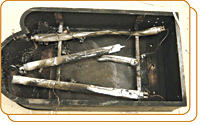
Hong Kong is world-famous for her bright colourful neon signboards all over the streets. Many of these signboards are lightboxes with fluorescent tubes inside for illumination purpose. Most lightboxes are placed outdoors. However, in recent years, it has been quite common to install lightboxes indoors (e.g. in shopping arcades, caf?ms and restaurants). Having been connected to the power supply, a lightbox will become a part of a fixed electrical installation. We all know that an electrical installation not properly designed, installed, inspected and maintained may give rise to an electrical accident (such as an electric shock or a fire). A minor accident may cause damage to property, while a major one may result in death and injury.
There is no specific design for these lightboxes, whose shapes are determined by the users' needs. Structurally, the outer translucent part is usually made of plastic sheets and fitted in a metal frame. Some lightboxes contain fluorescent tubes without supporting structure. The wiring and components of the fluorescent tubes inside are usually so arranged that light penetration will not be affected. Most of the lightboxes are designed and manufactured by advertisement companies and left REWs for power connection. At the manufacturing stage, a lightbox is not a part of a fixed electrical installation, thus a REW may not be involved. A REW must ensure that a lightbox complies with the Electricity (Wiring) Regulations and issue a Work Completion Certificate (Form WR1) to the owner of the electrical installation before energisation for use.
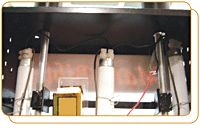
We have found that these lightboxes vary greatly in their quality. Therefore, in this issue, we provide safety tips for using lightboxes for the reference of the industry.
- Equipotential bonding
Most of the framework of a lightbox is made of metal, which is very close to the live parts. According to the Electricity (Wiring) Regulations, equipotential bonding is necessary for this metalwork for safety reasons.
- Wiring arrangement
Due to limited space, it may not be possible to install cable trunkings or cable ducts inside a lightbox for fixing the wires. Under such circumstances, surface wiring should be adopted to fix wires with "cable clips" or cable trunkings. Most of the lightbox enclosures are made of plastic sheets and the space available for fixing "cable clips" is limited. Thus the manufacturers generally use plastic cable trunkings for fixing the wires. In any case, the wires should not be made to twine around the fluorescent tubes or other components as this may hamper future maintenance or replacement of components. When the components are heated, the insulation of a cable sleeve will reduce, thus losing its flexibility and becoming brittle. When a cable sleeve comes off, the bare conductor may cause a short circuit or an electric leakage, which will result in a fire or jeopardise our safety.
- The use of safe components for fluorescent tubes
Only components meeting the applicable international standards should be used. Do not use substandard or unusual components to support a fluorescent tube (for example, do not connect wires directly to the electrodes at both ends of a fluorescent tube).
- The use of a proper ballast
A ballast, commonly known as "transformer", is an important component of a fluorescent tube. A ballast with higher consumption may be comparatively cheaper but releases more heat. Hence, objects close to it may easily get over-heated or burnt. A "transformer" with less consumption (such as an electronic ballast which complies with the standard) is preferred for reduction of heat generation.
- Dissipation of Heat
Heat will be generated when the fluorescent tube and its components in a lightbox have been connected to power. Poor heat dissipation may make the objects inside or near the lightbox burn and a fire may occur. Hence, a waterproof heat dissipation outlet should be provided for a lightbox.
- Proper installation
A lightbox must be securely fixed on a structure or its framework. Do not use electricity supply lines for hanging a lightbox.
To ensure electrical safety, follow the above tips and arrange regular inspection and maintenance of a lightbox.
Promotion of Household Electrical Safety to the Filipinos and Indonesians Living in Hong Kong
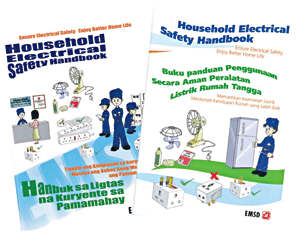
According to statistics, there are over 200,000 Filipinos and Indonesians living and working in Hong Kong, most of them being domestic helpers. In order to promote household electrical safety to these expatriates, we published the Household Electrical Safety Handbook in Filipino (Tagalog) and Indonesian in early 2004 and late 2005 respectively for free distribution. Expatriate domestic helpers are good helpers at homes. Their knowledge of proper use and maintenance of household electrical appliances is a must to household safety. Interested parties can obtain the Filipino or Indonesian Household Electrical Safety Handbook at the EMSD Customer Services Office, G/F, the EMSD Headquarters, 3 Kai Shing Street, Kowloon Bay, during office hours.
Incidents Relating to Electric Fans
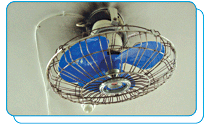
In 2005, there was an increase in the number of incidents relating to household electric fans in Hong Kong over the previous year. Our investigations revealed that 25 electrical incidents were caused by household electric fans and most of the incidents resulted in fires. Different types of fans, including wall-mounted fans (7 incidents), stand fans (4 incidents), ceiling fans (4 incidents), box fans (4 incidents) and exhaust fans (6 incidents), were involved in these incidents.
Investigations into the incidents relating to electric fans found that the fires were mainly caused by:
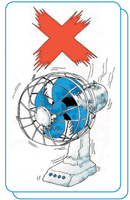 Lack of regular clean-ups
Some users do not have a habit of cleaning up their electric fans regularly. Dust and dirt may accumulate on the fan guard and fan motor enclosure, which may hamper the normal operation of the electric fan and heat dissipation of the fan motor. When the fan motor is overheated, a fire will break out.
- Lack of proper maintenance
Some users ignore the danger of using electric fans with defects or abnormalities (e.g. the fans have difficulties in movement, fail to move, produce too much noise, vibrate excessively) and do not arrange proper maintenance of the fans.
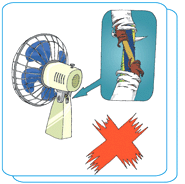 Damaged flexible power cords
The flexible power cord connecting the moving and static parts of an electric fan may have been damaged after prolonged use, causing danger arising from short-circuiting or exposure of live parts.
- Defective components
Some components of fans (such as capacitors) may become worn out after prolonged use or years of usage.
On the other hand, the latest applicable safety standards for household electrical products issued by the International Electrotechnical Commission (IEC) have tightened the test requirements (including the requirements for heat and flammability resistance of the electrical materials) for some items. To ensure the safety of electric fans, the number of oscillation tests required for electric fans has been increased from 10,000 cycles to 100,000 cycles.
Regular Maintenance of Fixed Electrical Installations in Buildings
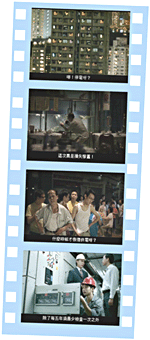
The electricity supply to the building was suspended for over 30 hours. There was neither water supply nor air-conditioning. The occupants had to carry water upstairs. No customers patronised the restaurants because the food had spoiled and the seafood was found dead...
This was a real case, not part of a film. Last year, a power failure occurred in a building whose owners were suspected to have failed to arrange proper maintenance for the communal fixed electrical installations. It caused inconvenience to residents and loss of property. Luckily there was no death or injury in the incident.
Recently, we have produced a new series of announcement of public interest (API) on TV and radio to enhance public awareness of the importance of regular inspection and maintenance of fixed electrical installations. The API has been broadcast on local TV and radio channels since mid-February this year.
To effectively prevent electrical incidents, owners of buildings should arrange proper maintenance and repair of the communal fixed electrical installations in their buildings.
A Distinguished Civil Service
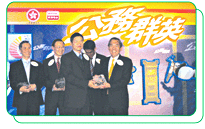
In order to commend the civil servants for their spirit in serving the community, the Civil Service Bureau (CSB) commissioned the Radio Television Hong Kong (RTHK) to produce a television series "A Distinguished Civil Service". Our Electricity Legislation Division (ELD) was invited to appear in one of the episodes. This was an indication that the efforts and contributions made by the ELD had gained recognition by the public and the trade. "A Distinguished Civil Service" was broadcast on TVB Jade on the evening of 11 March. To enhance public understanding of the filmed departments, the ELD provided some useful information to the RTHK for "A Distinguished Civil Service" documentary series exhibition held at the Hong Kong Museum of History between 3 January 2006 and 20 March 2006.
Civil Service Outstanding Service Award Scheme 2005
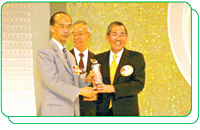
Since 1999, the Civil Service Bureau (CSB) has launched the Civil Service Outstanding Service Award Scheme annually. Last year, the scheme received a very good response and attracted over 130 nominations. The "Co-ordinated Maintenance of Buildings Scheme" implemented by the EMSD [the Electricity Legislation Division (ELD) and other regulatory service divisions] together with the Buildings Department and five other government departments won the Partnership Award in the Civil Service Outstanding Service Award Scheme 2005. Our ELD also won a Merit Award in the Specialised Service.

The prize presentation ceremony was held at the Queen Elizabeth Stadium on 2 December 2005. The then Secretary for Civil Service (SCS), Mr. Joseph W.P. WONG, officiated at the ceremony. Among the attendees were some members of the Legislative Council and the District Councils. At the prize presentation ceremony, Mr. WONG congratulated us on our achievement and encouraged us to make continuous improvements.
Establishment of the Third Underground Cable Detection Training Centre
Electricity supply lines are used for transmitting, distributing and supplying electricity. If a worker working in the vicinity of an electricity supply line severs or damages the line, there may be a danger that the working personnel and the people nearby will get electrocuted or burnt. The electricity supply may be interrupted, causing inconvenience to the public. Such an incident may also result in deaths, injuries and economic losses. To ensure personal safety and continuous electricity supply, the Electricity Supply Lines (Protection) Regulation stipulates that before the commencement of all excavation works, underground cable detection must be carried out by a "competent person" to ascertain the existence of underground electricity cables at the proposed site and its vicinity and a detection report must be submitted.
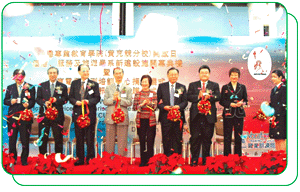
In 2000, the Electrical and Mechanical Services Department published the Code of Practice on Working near Electricity Supply Lines. On 1 October 2005, the Code of Practice was revised to provide clearer and more detailed guidelines with a view to reducing accidents. Following this revision, more "competent persons" will be needed. Recently, we have approved the establishment of the third underground cable detection training centre at the Hong Kong Institute of Vocational Education (Haking Wong) by the Vocational Training Council (VTC) to provide a well equipped venue for training "competent persons" for underground cable detection. The Director of Electrical and Mechanical Services, Mr. LAI Sze-hoi, was invited by the VTC to officiate at the opening ceremony of the training centre on 2 December 2005. In future, we will continue to work closely with and provide assistance to the relevant organisations in order to enhance electrical safety and our quality of life.
Electrical Work Safety Quiz
1.
|
If an overhead electricity line erected in a construction site does not cross any road, what is its minimum ground clearance?
|
| |
- 4.2 m
- 4.8 m
- 5.2 m
- 5.8 m
|
2.
|
According to the Electricity (Wiring) Regulations, what is the approved loading (in ampere) of a low voltage fixed electrical installation, single or three phase, in a factory or industrial undertaking, that is required to be inspected, tested and certified at least once every 5 years?
|
| |
- > 60
- > 100
- > 200
- > 400
|
3.
|
If an earth fault occurs at a fixed electrical installation in a bathroom, within what time should the circuit be disconnected?
|
| |
- 30 ms
- 50 ms
- 100 ms
- 400 ms
|
4.
|
When short circuit occurs, the electromagnetic force of a busbar is directly proportional to the...
|
| |
- short-circuit current
- square of short-circuit current
- rated voltage
- square of rated voltage
|
( Answers : 1C, 2C, 3D and 4B )
Correction: in the previous Electrical Work Safety Quiz, the correct answer to question 4 is A. Please accept our apology.
Feedback


We look forward to receiving your valuable feedback about this newsletter so that we may continue to improve it. Please complete the feedback form and return it to our Electricity Legislation Division by post, fax or e-mail on or before 15 June 2006 (please refer to the contact information below). To show our appreciation, the first 500 (see Note 1) respondents will receive a 4.5" tall stuffed Doraemon.
Note 1 : Please excuse us for not notifying those not among the first 500 respondents.
Contact Information
Electricity Legislation Division, EMSD, 3 Kai Shing Street, Kowloon, Hong Kong
1823 (Hotline)
2895 4929
info@emsd.gov.hk
8th Issue (April 2006)

