EMSD Summit – Imaginovate HK
Charles K.Kao Auditorium, Hong Kong Science Park
17 November 2016
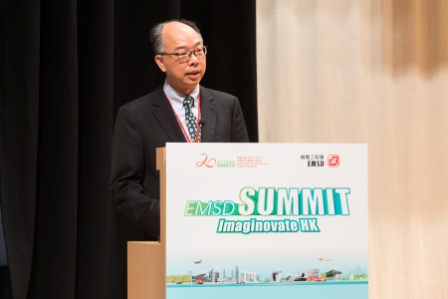
2016 is a year to be remembered. In the United Kingdom, the Brexit referendum turned out to be an incredible surprise with aftershocks and repercussions yet to be reconciled. In the United States, the presidential election ended with unbelievable outcome and wounds to bind. At global level, the Paris Agreement entered into force just two weeks ago. And for the first time, it brings all nations into a common cause to combat climate change. These and many other happenings across the globe simply reminded us that nothing is impossible.
Over time, humanity has created things of all kinds, including objects that fly beyond the sky, drugs for the body and music for the mind. If we are to realize and appreciate more on what we have done on our planet Earth, let’s take a brief look back in time. Pre-industrial atmospheric carbon dioxide level had never come close to 300ppm. In 2013, the atmospheric CO2 concentration surpassed 400ppm for the first time in recorded history. Now it stays constantly above 400ppm since November 2015. Just three days ago, assessment by the World Meteorological Organization indicated that 2016 will be very likely the hottest year on record. Preliminary data shows that 2016's global temperatures are approximately 1.2°C above pre-industrial levels.
Article 2 of the Paris Agreement highlights the objective to holding the increase in the global average temperature to well below 2°C above pre-industrial levels and pursuing efforts to limit the temperature increase to 1.5°C. While all nations have adopted the limits as their goal, the Oxford University pointed out that the atmosphere could only take a trillion tonnes of carbon emissions before reaching the 2°C limit. The task is daunting because human activity up to now has already exhausted more than 60% of that quota.
While 2016 is a year to be remembered, NOW is the defining moment for us all to shape the future. By 2050, 66 per cent of the world’s 9.7 billion population is projected to be urban. For every three persons on Earth, two of them will be living in urbanised areas. In pace with the growing population and human activities, the International Energy Agency expects a 50% rise in global energy consumption by then. As such, sustainable development is of vital importance, especially when Hong Kong is at the forefront of urbanisation.
With limited natural resources and aging population, how are we going to plan and build our city, bearing in mind Hong Kong people’s aspiration for lifestyle and healthcare, conservation and development, energy and transport, as well as technology and innovation? Not only we have to make our city sustainable, we have to make it smart and regenerative too. For these very reasons, we are honoured to have the many prominent figures and leaders to take time out of their busy schedules to share with us their thoughts and wisdom for the future. We are particularly thankful to the heavy-weight speakers from overseas who come all the way to Hong Kong. Welcome once again to everybody here today and we look forward to a fruitful exchange.
In closing, I would like to share with you a quotation by Nobel Laureate George Bernard Shaw. He said: “People are always blaming their circumstances for what they are. I don’t believe in circumstances. The people who get on in this world are the people who get up and look for the circumstances they want, and if they can't find them, make them”. Indeed, the future of Hong Kong is in the making and it is up to us to imaginovate. Thank you.
17 November 2017
[End]
Text script [PDF format (51KB)]