TRANSPORT
Your Car and the Environment
Transport Energy Use in Hong Kong
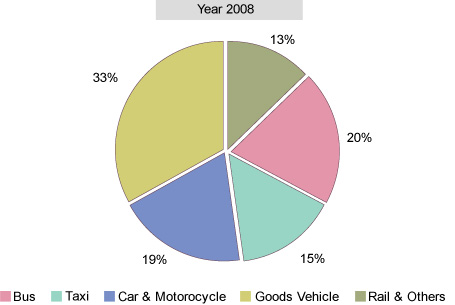
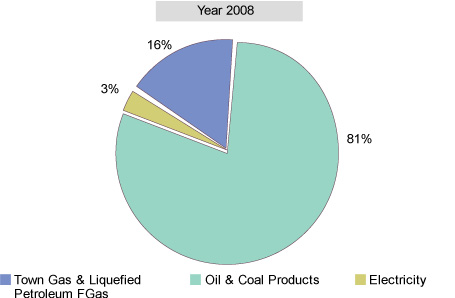
According to Hong Kong Energy End-use Data 2010, transport energy use accounts for 32% of total energy consumed within Hong Kong at end-use level in 2008. This has not taken into account the large amount of fuels for international flights and ocean-going vessels. Three major types of fuels are used for local transportation purpose – oil & coal products, town gas & liquefied petroleum gas (LPG) and electricity (not counting aviation fuel for aeroplanes and fuel oil for ocean-going vessels).
Generally speaking, petrol is used mainly for passenger vehicles; diesel for buses, goods vehicles, and marine vessels; LPG for taxis; and electricity for railways and metro.
Emissions
Burning of fossil fuels in internal combustion engines produces a lot of emissions - nitrogen oxides, carbon monoxide, sulphur dioxide, unburned hydrocarbons, particulates. Another combustion product of much concern is carbon dioxide which is a major greenhouse gas. According to the data of 2007 Hong Kong Air Pollutants Emission Inventory, emissions due to vehicles, navigation and civil aviation in 2007 amount to (approximately):
|
|
|
| Respirable Suspended Particulates (RSP) | 2119 tonnes |
| Sulphur Dioxide | 4453 tonnes |
| Nitrogen Oxides | 41,350 tonnes |
| Volatile Organic Compound (VOC) | 8331 tonnes |
| Carbon Monoxide | 63,530 tonnes |
|
|
|
Motor vehicles, especially diesel vehicles, are the main causes of high concentrations of respirable suspended particulates and nitrogen oxides at street level in Hong Kong.
Your Car and the Environment
Vehicles are one of the major sources of air pollution, emitting smoke, respirable particulates and chemicals such as carbon monoxide (CO), hydrocarbons (HC) and oxides of nitrogen (NOx) which are not only harmful to our health, but also reduce the visibility in urban areas. Moreover, vehicles also emit a large quantity of carbon dioxide (CO2) which is one of the principal greenhouse gases that is responsible for global warming.
In recent years,both developments of the legal framework and new vehicle technology have resulted in important improvements in energy consumption and emissions of vehicle. Since 1 October 2006, newly registered heavy duty vehicles over 3.5 tonnes are required to comply with Euro IV emission standards. A Euro IV diesel vehicle emits about 95% less particulates and 60% less nitrogen oxides than a pre-Euro vehicle manufactured before 1995.
At the same time, numerous improvements have been made to ensure much cleaner emissions from road vehicles. Improvements include
- Advanced combustion technologies, for example, direct injection and optimised combustion of fuels, fuels containing considerably less lead and sulphur, electronic fuel management, etc. contributed to more efficient and cleaner motors;
- Improved exhaust technologies include filters and catalytic converters. Technological developments have, for example, enabled the constant reduction in the quantities of NOx, CO and other volatile organic compounds emitted by vehicles;
- Lighter and stronger materials, meaning that less energy or fuel is used to power the same motor so that the CO2 emission will be lowered.
Obviously, choosing a more fuel-efficient car will help reducing pollution and energy consumption. A car consuming 8 litre/100 km will emit about 10,000 kg less carbon dioxide over its life-time than a car consuming 12 litre/100 km. Of course you also save money by choosing the more efficient car.