| |
|
|
Promoting
Energy Efficiency
EMSD has always played
an active part in promoting the notion and application of energy efficiency
to the public and to the relevant trades. Within the government,
EMSD has always been supporting other departments to achieve energy
savings by giving advice and conducting energy audits as well
as helping them to install energy-efficient equipment.
Early this year, EMSD had successfully brought together over 200
prominent overseas and local participants from professional
bodies, utilities, trade associations, academic institutions,
consultants, government departments, and other related parties
to a common occasion – the Forum on Energy Efficiency Conservation
held on 14 January 2003 – with an aim to enhancing their mutual
understanding on the latest developments in energy efficiency
and conservation. Renowned guest
speakers from the State Development Planning Commission of PRC,
APEC Energy Working Group, Asia Pacific Energy Research Centre,
US International Centre for Sustainable Development, as well as
EMSD made presentations on topics such as energy policy and
energy efficiency, new and renewable energy, energy outlook and
energy data. Riding on the success of the forum which
met with unanimous applause, EMSD is further planning more energy-promoting
events in the coming years.
|
|
 |
|
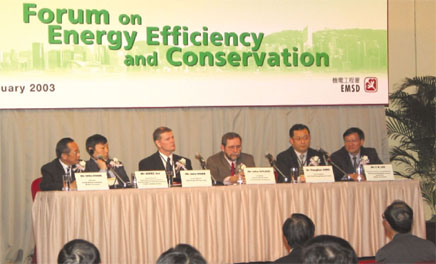
| Mr.
Otto Poon, Chairman of the Energy Advisory
Committee, co-hosts with other guest speakers
the Discussion Session in the Forum on Energy
Efficiency and Conservation. |
|
|
|
In
addition to the forum, EMSD also organised a number of briefings
on energy saving to bureaux and departments (B/Ds) from
April to June this year in line with the ETWB’s initiative
of Enhancing Green Management Practice promulgated
via their circular memo on 31 March 2003. The Enhancing
Green Management Practice initiative aims to economise on
the use of resources by encouraging B/Ds to reduce
energy and paper consumption. In the area of energy
saving, B/Ds are encouraged to achieve a 6% saving in energy
consumption in four years from FY2002/03 to 2006/07.
In order to provide practical guidance to B/Ds on how to
achieve the savings, EMSD organised four briefing sessions
for them, on 28 April, 15 May, 5 June, and 9 June respectively.
Two
of them were originally planned.
In
light of
the overwhelming response, and in order not to miss out
anyone wishing to attend the briefings, two more sessions
were added. More than 1,000 officers attended the
four briefings. During the briefings, colleagues were informed
about the various energy saving measures and some typical
projects carried out by EMSD. |
|
|
|
Energy saving measures are normally grouped into three categories
according to their implementation cost. Category 1 measures
are those with practically no cost implication for implementation,
principally by means of better housekeeping such as switching
off lights and equipment when they are not required and properly
setting the room-temperature thermostats. It is often surprising
how much energy can be saved simply by changing our energy use
habits.
|
|
Beyond
that, a certain amount of investment and technical support
are required. Category 2 measures require relatively
“less” capital costs to implement, with payback periods
of typically less than three years. Category 3 measures
require substantial investments and are technically more
complicated, with payback periods ranging from three to
six years. Some examples will better illustrate the
economics. In September 2001, EMSD replaced 1,600
T8 fluorescent tubes in General Post Office (GPO) with the
more efficient T5 tubes. Energy saving was about 40%,
trimming off 42,000 kWh a year, and payback period was only
14 months. In September 2000, we retrofitted the lighting
installation at East Kai Tak Indoor Games Hall with high-output
T5 luminaries. Compared
with the previous installation, 49%
energy saving, equivalent to 60,000 kWh per annum, was achieved,
with a payback period of about three and a half years. Other
than saving cost, the new installation also provides better
quality
illumination. Another example involved the retrofitting
of evaporative cooling for condensers in an air-conditioning
system in GPO. The annual saving was about 50,000 kWh
and payback period was only 20 months. These examples
illustrate that investment put into energy saving retrofits
will pay off in just a couple of years. |
 |
|
|
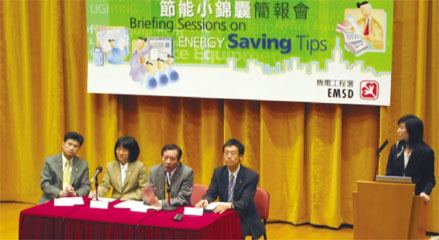
Speakers
answer questions from the audience at the
Briefing Session on Energy Saving Tips. |
|
|
|
To
assist B/Ds, the presentation materials of the briefings have been
uploaded to the CCGO Green Management corner for access by B/Ds.
Along with the briefings, EMSD has prepared a booklet “Energy Saving
Tips” as guidelines in energy conservation and distributed to each
participant. An electronic version is also made available for access
through EMSD’s interactive website “EnergyLand” (http://www.energyland.emsd.gov.hk).
Saving
energy is an established government policy. EMSD
will give all necessary support to this initiative, and is
doing its best to provide technical advice to B/Ds to achieve
the consumption reduction target. As the authority on energy efficiency,
EMSD is always in a position to give its advice and share its
experiences on saving energy for the common good of Hong Kong.
|
|
|
Back
to Top
|
|