"New Energy", or sometimes "New and Renewable Energy", generally refers to energy resources and energy carriers other than the traditional fossil fuels of oil, gas, and coal, and nuclear energy. Such energy resources and carriers cover both renewable and non-renewable ones including solar energy, wind energy, geothermal energy, ocean energy, biomass, small-scale hydro, hydrogen energy, and natural gas hydrates. The term can also be interpreted to include new energy technologies such as fuel cell technologies which utilise the chemical reaction between hydrogen and oxygen to generate electricity without combustion or mechanical movements.
Information on Renewable Energy
EMSD has published the following information pamphlets / guidance notes aiming to provide information to the public on the applications of renewable energy technologies:
"Know More About Renewable Energy" [PDF format (3.40MB)] - explains the meaning of renewable energy and the benefits of using renewable energy.
"Know More About Solar Water Heating System" [PDF format (3.97MB)] - explains the principles of solar water heating system and provides an overview of the basic components, types of systems and issues to be considered for installation.
"Guidance Notes for Household-scale Solar Water Heating System at Village House" (2016 Edition) [PDF format (3.73MB)] - provides general guidelines for the intending purchasers, owners and installers of household-scale solar water heating system installed at village houses to understand the installation requirements and application procedures associated with the installation, operation and maintenance of such solar water heating system.
"Solar Thermal Collectors for Water Heating" [PDF format (4.74MB)] –provides a brief introduction on solar thermal collectors which capture solar heat for water heating purpose.
"Know More About Photovoltaic System" [PDF format (3.68MB)] - provides information on the working principles and application considerations etc.
The HK RE Net is a thematic website aiming to provide information on various renewable energy technologies to the public, so as to facilitate the wider adoption of such technologies in Hong Kong. Click here to visit the site.
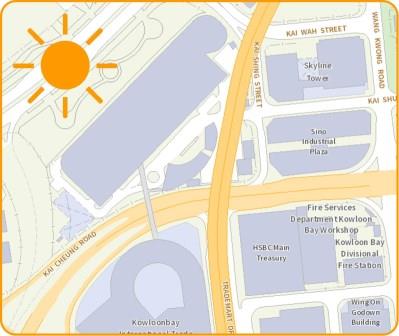 Hong Kong Solar Irradiation Map
To prompt more building owners to install solar photovoltaic (PV) systems, the Electrical and Mechanical Services Department (EMSD) launched the Hong Kong Solar Irradiation Map (the Map) in 2021. By showing the solar irradiation of the building rooftops, the Map enables users to perform a preliminary assessment of the solar energy potential for their building rooftops. Users can also choose the solar PV system settings and select an installation area on their building rooftops as shown on the Map to estimate the corresponding installation capacity, the annual electricity generation, and the FiT income.
This is the first-ever detailed annual solar irradiation map of the entire Hong Kong territory for most of the buildings with the consideration of topographic and shading effects of surrounding environment. For more details about the Map, click here to visit the site.
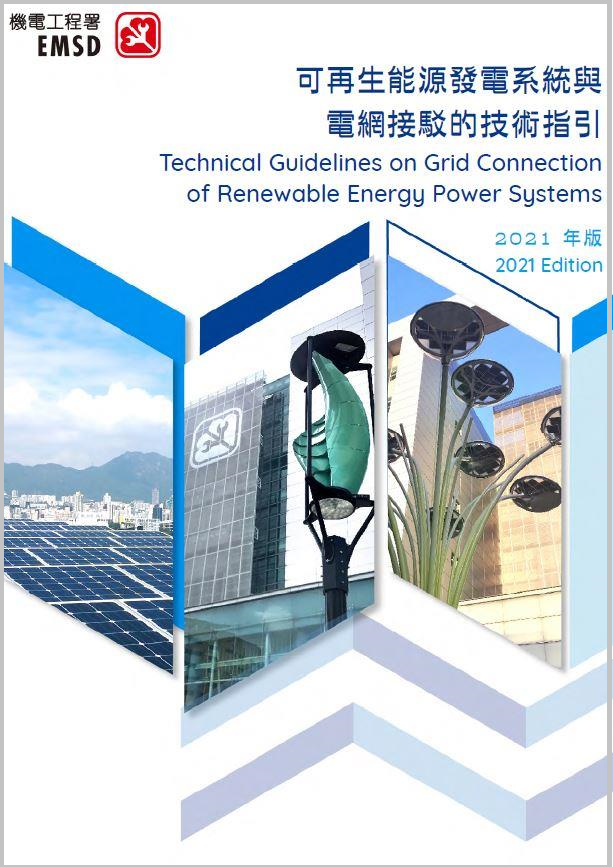 Technical Guidelines on Grid Connection of Renewable Energy Power Systems
Although renewable energy resources can contribute to mitigating the problems associated with the use of fossil fuels, most of them are intermittent in nature. It is therefore necessary to have a backup power supply such as the electricity grid to meet the demand when the electricity generated by the renewable energy system is unable to provide the power required.
To assist the public to better understand the technical issues relating to grid connection of Renewable Energy (RE) installations, the Electrical and Mechanical Services Department (EMSD) has compiled a "Technical Guidelines on Grid Connection of Renewable Energy Power Systems" (hereinafter referred to as “Technical Guidelines”). The Technical Guidelines addresses the aspects of safety considerations, system protection, power reliability, major devices and their functions, testing and maintenance for grid-connected RE power generation systems.
In view of the implementation of the revision of the Code of Practice for the Electricity (Wiring) Regulations in December 2020, the Technical Guidelines was revised in 2021 to incorporate the updates.
Please click here to download the "Technical Guidelines on Grid Connection of RE Power Systems" (2021 Edition) [PDF format (5.39MB)], and here to download the "Summary Table of Updates" (information updated as of 3 March 2022) [PDF format (83KB)].
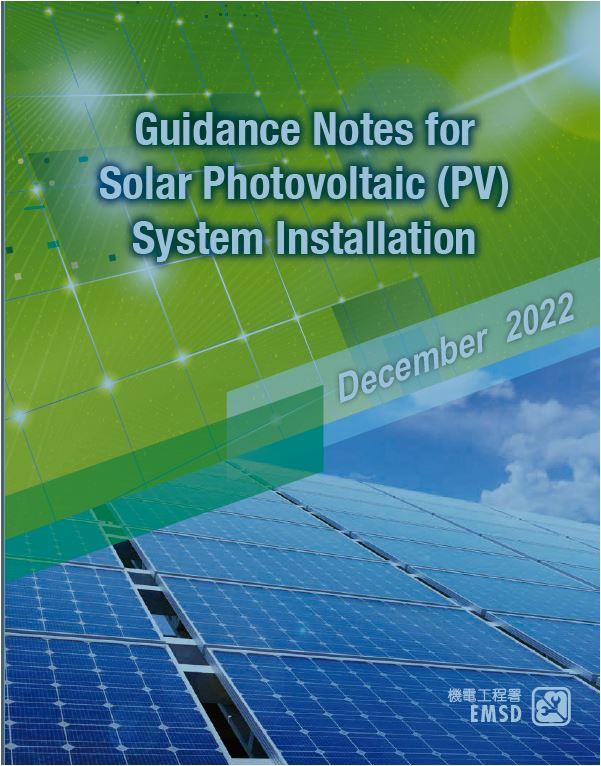 Guidance Notes for Solar Photovoltaic
To assist the public to better understand the issues related to solar PV system installations and the FiT application procedures, a Working Group was formed with members from the Environment Bureau (ENB) (retitled as the Environment and Ecology Bureau (EEB) with effect from 1 July 2022), the Electrical and Mechanical Services Department (EMSD), the Lands Department (LandsD), the Planning Department (PlanD), the Buildings Department (BD) and the Fire Services Department (FSD) to develop the "Guidance Notes for Solar Photovoltaic (PV) System Installation". This set of Guidance Notes provides general guidelines for intending purchasers, owners and installers of solar PV systems to understand the installation requirements and FiT application procedures associated with the installation, operation and maintenance of such systems. The "Guidance Notes For Solar Photovoltaic (PV) System Installation (December 2022)" [PDF format (15.33MB)] can be downloaded from the HK RE Net website of the Electrical and Mechanical Services Department.
Renewable Energy Projects
In Hong Kong, the primary use of solar energy is to provide hot water for facilities with heating demand or to generate electricity directly. Some small-scale photovoltaic and wind systems have been installed in remote areas to generate nominal electrical power for lighting and on-site data recording equipment.
Renewable Energy Study
In 2000, a two-stage consultancy study was commissioned to investigate the viability of using renewable energy resources such as solar energy, wind energy, wave energy, landfill gas, etc. in Hong Kong. Stage 1 of the study evaluated the potentials of various forms of renewable energy for wide-scale local use, and their related legal, institutional and promotional issues. It also made recommendations for formulating an implementation strategy. Public consultation on the findings and recommendations was carried out in 2003. Relevant documents can be downloaded via the following links:
Stage 2 of the study involved the installation of different types of photovoltaic panels in Wanchai Tower so as to collect technical data to assess their performance under local weather and environmental conditions. The 12-month performance monitoring work was completed in March 2004. Click here to download the Executive Summary of Stage 2 Study [PDF format (526KB)].
New & Renewable Energy