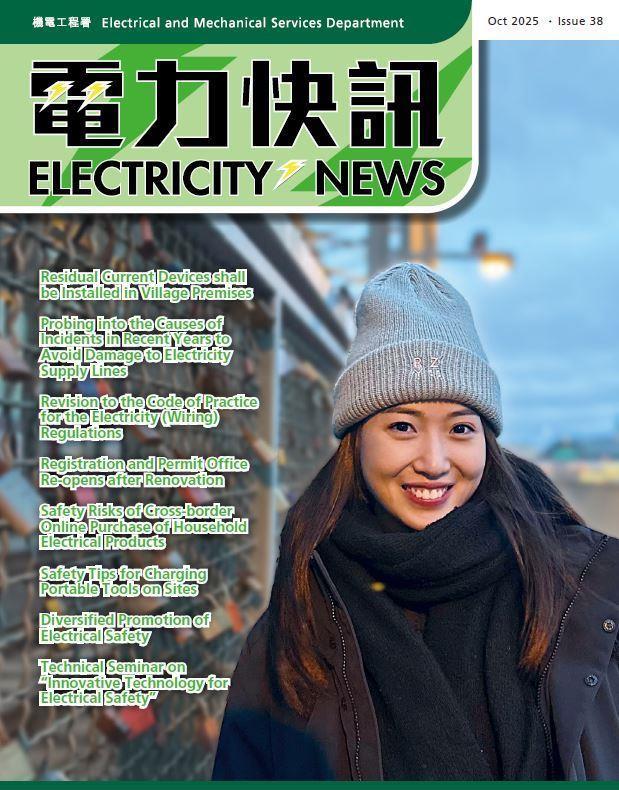
Athlete YAM Hui-yin|
E:
Electricity News
Y:
YAM Hui-yin
|
|
|
|
|
|
E:
|
Hello, Hui-yin. Why don't you start by telling us a bit about yourself? |
|
Y:
|
Hello, I'm YAM Hui-yin, currently a member of the Hong Kong Women's Basketball Team, also Captain of the Fukien Team in Division 1 of the Hong Kong Women's Basketball League. I represented Hong Kong in the 5x5 game at the Hangzhou 19th Asian Games in 2023. I once again represented Hong Kong at the FIBA (International Basketball Federation) 3x3 Asia Cup in Singapore this March, and the 5x5 game at the FIBA Asia Cup Division B - East Asia Qualifiers in April. |
|
E:
|
You've competed in so many major events for Hong Kong both on the Mainland and abroad. That's really impressive! |
|
Y:
|
Thank you. By the way, I've recently moved into a village house. Are there any electrical safety precautions I should be aware of? |
|
E:
|
You're asking at just the right time. This issue of Electricity News features an article on the installation of residual current devices for electrical installations in village premises. We're highlighting key safety considerations for electrical installations in village premises. As a reminder, according to the Electricity Ordinance (Cap. 406), no person shall employ a person other than a registered electrical contractor (REC) to carry out electrical work. Furthermore, in general, no person shall do personally or offer or undertake to do electrical work personally unless he is a registered electrical worker (REW) who is entitled by his certificate to do the work. So, if you need any electrical work done at home, make sure to hire an electrical contractor registered with the Electrical and Mechanical Services Department (EMSD) to ensure electrical safety. Also, RECs normally assign REWs to do the work. If necessary, you may request the REWs on site to present their certificates of registration for identity verification. Both the REC and REW registers are available on the EMSD website. Before hiring an REC, don't forget to check the register online! |
|
Y:
|
Whoa, I don't realise there's so much to keep in mind. Thanks for the heads-up. I'll check out the registers on the EMSD website in a bit. |
|
E:
|
This issue of Electricity News has loads of great content, hope you'll support us. |
|
Y:
|
Of course! I'll definitely share it with my friends and family as well! |
Generally speaking, the electrical protection systems of household fixed electrical installations protect electrical installations and guarantee the safety of users mainly by means of over current protection (e.g. miniature circuit breakers or fuses), residual current protection (e.g. residual current devices (RCDs)) and earthing protection. Users should employ qualified registered electrical contractors (RECs) to install and maintain electrical protection systems, in order to ensure that they operate normally and provide effective protection.
After years of wear and tear, the earthing systems of fixed electrical installations in village premises (e.g. village houses) may have problems with earthing conductors such as rusting, intermittent connection, loose contact, mechanical damage and conductor breakage, resulting in poor earthing, and hence fail to meet the safety requirements of effective earthing and provide effective protection. Most of the electrical accidents that occurred in village premises involved dual inadequacies, namely poor earthing and lack of RCD installation. If a fixed electrical installation in village premises does not have effective earthing connection, the earth fault loop impedance will be too high. When an earth fault occurs in a piece of electrical equipment in the premises, the earth fault current in the circuit may be insufficient to activate the overcurrent protective device. Such circumstances coupled with the lack of protection by an RCD, the earth fault current cannot be automatically interrupted, eventually resulting in an electrical accident.
♦ RCDs
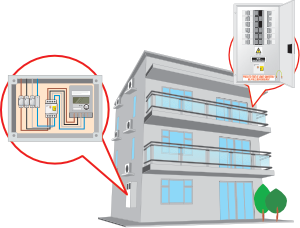
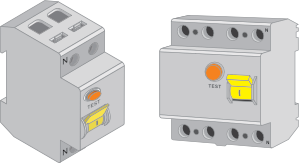
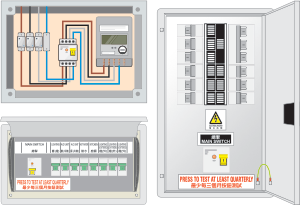
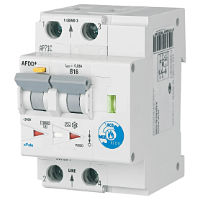
To prevent such incidents, fixed electrical installations in village premises in the New Territories must be equipped with an RCD for further protection, so that the earth fault current can be automatically interrupted despite poor earthing. As required by Code 11J of the Code of Practice for the Electricity (Wiring) Regulations (CoP), protection by means of an RCD should be provided for fixed electrical installations supplied from an overhead line system and fixed electrical installations in premises on the List of Recognised Villages under the New Territories Small House Policy. To put it simply, owners of premises can meet the relevant requirements just by installing a main switch incorporated with an RCD upstream to the electric meter or in the distribution board.
♦ Main switches incorporated with RCDs installed upstream to the electric meter
Owners of village premises should take the initiative to engage RECs to carry out the periodic inspection of earthing systems. When registered electrical workers (REWs) carry out inspection to fixed electrical installations in village premises in the New Territories, they should pay special attention to whether the earthing systems of the premises meet the safety requirements. In addition to visual inspection, REWs should carry out earth fault loop impedance tests to ensure that the earth fault loop impedance of the circuits meet the safety requirements.
Moreover, RECs and REWs should explain to the owners of premises the importance of the installation and periodic testing of RCDs. If REWs find that a fixed electrical installation in the premises is not equipped with a main switch incorporated with an RCD upstream to the electric meter or in the distribution board, they should promptly install it for further protection. Besides, according to Code 17E of the CoP, they should display the notices of testing for RCDs, which indicate "Press to test at least quarterly" in legible characters not less than 5 mm in height.
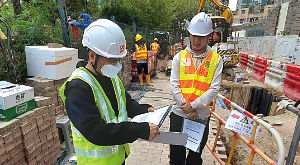
Incidents involving damage to electricity supply lines not only pose serious risks to workers but also disrupt social operations. The Code of Practice on Working near Electricity Supply Lines (the CoP) provides practical guidance on the requirements set forth by the Electricity Supply Lines (Protection) Regulation, with a view to ensuring that works carried out near electricity supply lines will not compromise safety or affect electricity supply. Although the number of relevant incidents has decreased significantly since 2000, cases of damaged electricity supply lines still occur from time to time. In the light of this, we will probe into the common causes of incidents in recent years, hoping that everyone can learn from these experiences and avoid the recurrence of similar accidents.
Failure to complete cable detection work before works commence
Before carrying out works near underground cables, the working party did not conduct any underground cable detection work, or only performed passive detection without toroidal active detection. As a result, the alignment and depth of the underground cables could not be ascertained, leading to occurrence of incidents.
After completing passive detection, the working party did not arrange for a competent person to supervise the excavation of trial holes in person, which led to occurrence of incidents during the excavation process.
When carrying out works near underground cables, site workers did not maintain the minimum safe working distance from these cables as required by the CoP. In some cases, workers cut corners and lead to accidents; while in some cases, the working party did not arrange for a competent person to brief site workers to ensure that they understood the contents of the competent person's written report, including the meaning of the site signs, potential hazards of cable damage, and necessary safety precautions.
Taking the above common causes into account, we urge all stakeholders in the trade to keep the following key points in mind to prevent the recurrence of similar incidents:
| Equipment used | Underground cable | Minimum safe working distance to be maintained |
| Hand-held power tools | Any voltage | 500mm in any direction from the cable (If breaking out of the paved concrete surface is necessary, a horizontal clearance of 250mm is required.) |
| Trenchless drilling and slope stabilisation works | Voltage below 132 kV | 1 metre in any direction from the cable |
| Voltage at 132 kV or above | 3 metre in any direction from the cable | |
| Trenchless drilling and slope stabilisation works | Any voltage | 1 metre in any direction from the cable |
| Vertical, horizontal or oblique penetration by hand-held tools or machinery | Any voltage | 500 mm in the horizontal direction |

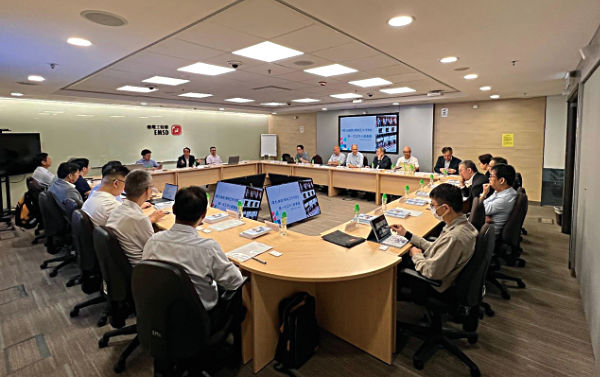
The Electrical and Mechanical Services Department (EMSD) debuted the Code of Practice for the Electricity (Wiring) Regulations (CoP) in 1992. We have been reviewing and revising the CoP regularly to ensure that all safety and technical requirements keep up with the times. We have commenced a new round of revision to the CoP, and established a working group in 2024 to collect the views of stakeholders in the electrical trade. The working group consisting of representatives of multiple trade organisations, professional bodies, academic institutions, power companies and government departments, is responsible for reviewing the latest international safety standards, existing trade practices and innovative technologies, and making recommendations for the revision, so as to maintain electrical safety in Hong Kong at a high level.

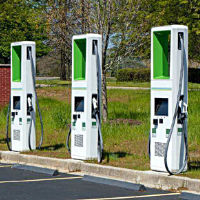
In addition, the EMSD has set up eight task forces comprising trade representatives under the working group for the first time. They offer opinions and suggestions on arc fault detection devices, electric vehicle charging facilities, high voltage installations, periodic inspection, testing and certification of fixed electrical installations, battery energy storage systems, smart switchboards, power supply units at sites and renewable energy power systems respectively. The new version of the CoP is expected to be published at the end of 2025, and will be fully implemented at the end of 2026 after a grace period of one year.
Arc Fault Detection Devices
Electric Vehicle Charging Facilities
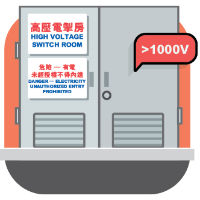
High Voltage Installations
Periodic Inspection, Testing and Certification of Fixed Electrical Installations
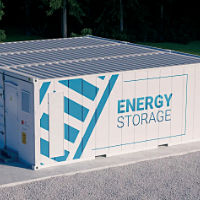
Battery Energy Storage Systems
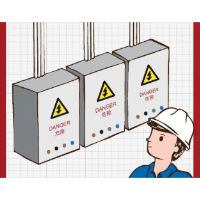
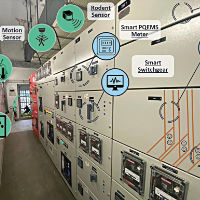
Smart Switchboards
Power Supply Units at Sites
Renewable Energy Power Systems
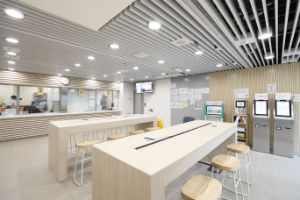
Upon the completion of the renovation works, the Registration and Permit Office, located on the ground floor of the Electrical and Mechanical Services Department (EMSD) Headquarters at 3 Kai Shing Street, Kowloon Bay, resumed service in May 2025. The new office is equipped with tablet computers and an "iAM Smart" self-registration kiosk, providing digital services that allow registered electrical workers (REWs) to access the online training platform of the Continuing Professional Development Scheme for REWs through "iAM Smart+". Moreover, the waiting area in the new office is more comfortable than before and complete with free Wi-Fi, offering a better service experience for the public.
The service hours of the new office remain unchanged, from 9:00 am to 5:15 pm, Mondays to Fridays (closed on Saturdays, Sundays and public holidays), and appointments for services can be made through "iAM Smart+". In addition to visiting the office in person, members of the public can also submit applications and make payments for various licences, certificates of registration or other certificates electronically through the EMSD (Regulatory Services) Web-based Registration Services and "iAM Smart+".
In recent years, cross-border online shopping has become popular, and many members of the public even purchase household electrical products online. However, if citizens are not careful in selecting cross-border household electrical products, they may be exposed to safety risks due to the following factors:

The rated voltage of cross-border household electrical products may not be the same as that in Hong Kong (i.e. 220 volts). The use of such products may not only cause damage to the products, but may also lead to fire.
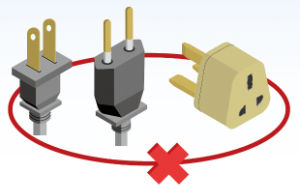
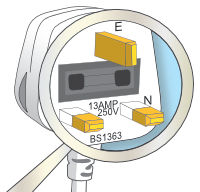
Cross-border household electrical products may have different power plug system (e.g. 2-pin plugs) from that in Hong Kong, and users therefore have to use adaptors. The use of adaptors that do not comply with the safety requirements, such as those with irregular holes, may result in poor contact and overheating, thus increasing the risk of fire.

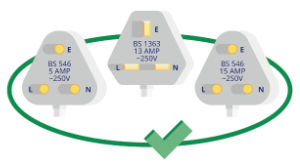
The Electrical Products (Safety) Regulation stipulatesthat all prescribed products, including plugs and adaptors, shall comply with specific safety requirements. Plugs shall generally be 3-rectangular-pin 13A plugs that conform to BS 1363, and 3-round-pin 5A or 15A plugs that conform to BS 546. In addition, all electrical products that receive power supply from a mains socket must be fitted with plugs that comply with specific safety requirements.
Source of image: Household Electrical Safety Handbook
In recent years, accidents involving chargers and batteries of portable tools have occurred on sites occasionally. Workers should pay attention to the following safety tips to reduce potential safety hazards for charging portable tools on sites.

When buying chargers and batteries of portable tools, remember to choose batteries produced or recommended by the original manufacturers, and chargers with three-pin plugs that are suitable to use in Hong Kong (i.e. plugs that comply with safety standard BS1363 or BS546). Buy chargers at reputable stores. Do not buy unbranded chargers or those from unknown sources.

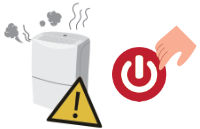
When charging portable tools on sites, workers should adhere to the instructions in the user manuals. Do not charge the batteries for a prolonged period of time, let alone overnight. Moreover, do not let the electrodes of the output connector come into contact with any metallic objects to avoid short-circuiting. If it is found that the chargers or portable tools are damaged, overheat, or make noises, exude odour or vibrate abnormally, etc., stop using them immediately and unplug them.

A charging area should be set up in a cool, dry and well-ventilated place on sites, away from high temperature, strong sunlight and moisture. The area should be kept clean, without any sundries, flammable objects or fugitive vapour. Suitable fire prevention equipment and monitoring devices should be installed to ensure safety. No more than one adaptor or one extension unit should be inserted into a socket outlet.
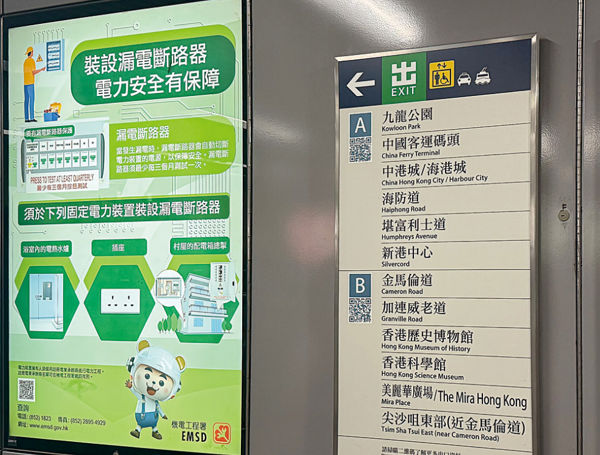
Have you recently seen posters promoting the installation of residual current devices in MTR stations, or relevant banners when browsing websites?
Electrical safety is of paramount importance to all citizens. As technology develops, power systems and electrical products have become an integral part of our daily lives. However, many people still lack an adequate understanding of electrical safety. Therefore, the Electrical and Mechanical Services Department actively explore new publicity methods to convey the message of electrical safety to all segments of society in a diversified manner, so that everyone can use electrical appliances safely and reduce potential risks.
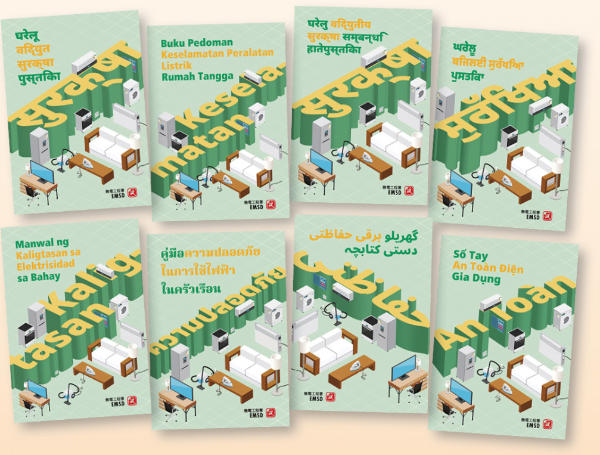
The public is the majority of stakeholders and the focus of our publicity. To make it easier for them to understand our message, we have debuted a series of simple-designed and easy-to-understand new posters. We have also produced posters in five minority languages to spread the message of electrical safety among minorities
♦ Publicity Posters in MTR Stations
♦ Household Electrical Safety Handbook in 8 minority languages
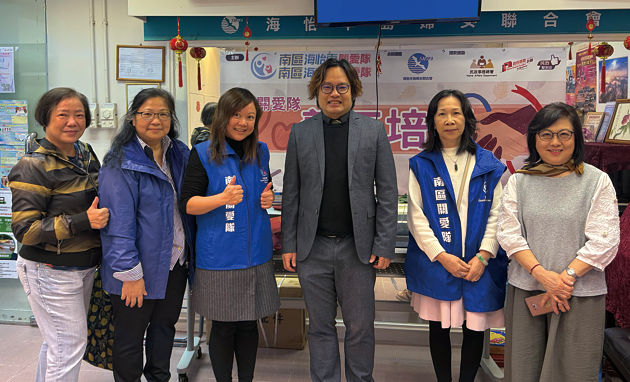
♦ Electrical Safety Training for South Horizons East and South Horizons West Care Teams
In addition to running publicity campaigns in MTR stations and online, we have actively reached out to the public to explain electrical safety issues. For example, in October 2024, we worked with Wong Tai Sin District Office and the Care Team of that district to visit the grass roots. During the visit, we introduced to the residents the precautions of using electrical products and answered their questions about electrical safety. To disseminate electrical safety information more effectively, we collaborated with South Horizons East and South Horizons West Care Teams to organise electrical safety training for the volunteers in February 2025.
The volunteers actively participated in the training and raised questions about electrical safety issues encountered in daily lives. We took this opportunity to expound on the importance of electrical safety and relevant regulatory requirements to them. We also utilised the advertising networks in different buildings to broadcast videos and information about electrical safety. We hope that the above publicity channels can provide the public with easier access to relevant information and cultivate awareness of electrical safety among them.
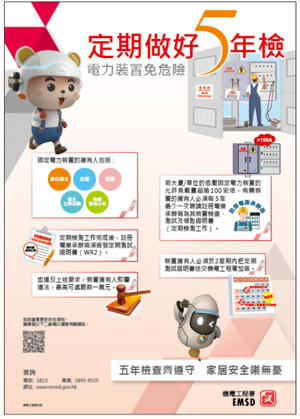
♦ "Conduct Periodic Inspection Every 5 Years" Poster
♦ Online platform display and promotion
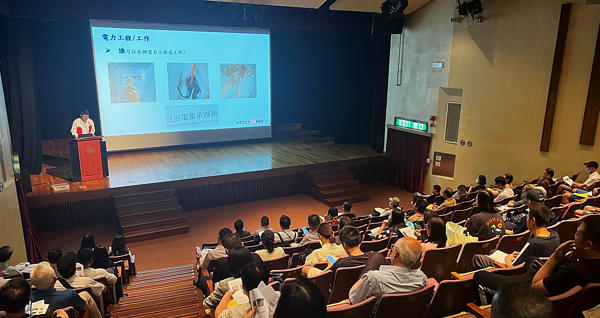
Besides, we have worked with different organisations and leveraged their community networks to further spread the message of electrical safety. True to form, we have actively participated in safety seminars organised by District Councils, the Hong Kong Hotels Association, the Estate Agents Authority, etc. This year, we also co-operated with the Hong Kong Council of Social Service, which has 520 agency members, to share knowledge about electrical safety with the relevant organisations and their members through its network established in the areas of rehabilitation services, children and youth services, elderly services, as well as family and community services.
Registered electrical workers are another major group of stakeholders in the electrical industry and thus also the focus of our publicity campaigns. To enhance their understanding of requirements for electrical work, we have entailed the information on regulatory requirements and procedures in our daily correspondence, reminding them to comply with the law and improve electrical safety.
♦ Seminar organised by the Estate Agents Authority
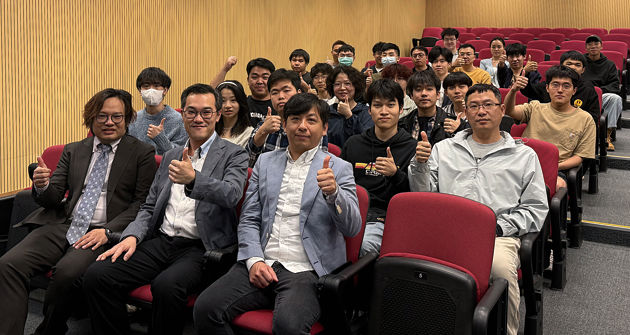
We firmly believe that fostering a good safety awareness from an early age will prompt the trade to pay more attention to electrical safety. Therefore, we have partnered with the Hong Kong Institute of Vocational Education (HKIVE), Hong Kong and Kowloon Electrical Engineering and Appliances Trade Workers Union, and Hong Kong Electrical Contractors' Association Limited to organise a pilot programme called Practice for Future. This programme offers training, practical experiences and project activities for students enrolled in the Higher Diploma in Electrical Engineering Programme at the HKIVE. We hope that this initiative will help students understand the working environment of the electrical industry, instil an awareness of electrical safety into them at an early stage, and prepare them for their future careers in the electrical field.
♦ "Practice for Future" Pilot Programme
Through these diversified publicity campaigns, we aim to enhance awareness of electrical safety among citizens, enabling them to take appropriate preventive measures in their daily lives and minimise the risk of incidents.
Committed to continuously enhancing the technical standards and electrical safety awareness of the electrical trade, the Electrical and Mechanical Services Department (EMSD) has co-organised the Annual Technical Seminar (the Seminar) every year since 2001 with the Hong Kong and Kowloon Electrical Engineering and Appliances Trade Workers Union (the Union) and the Hong Kong Electrical Contractors' Association (the Association). The Seminar this year was held on the evening of 13 January 2025 at the Kai Tak Community Hall with the theme of "Innovative Technology for Electrical Safety", attracting about 400 practitioners from the electrical trade, including registered electrical workers, professionals and representatives from academia. Participants actively expressed their opinions and asked questions, and had in-depth discussion and exchange with the speakers.
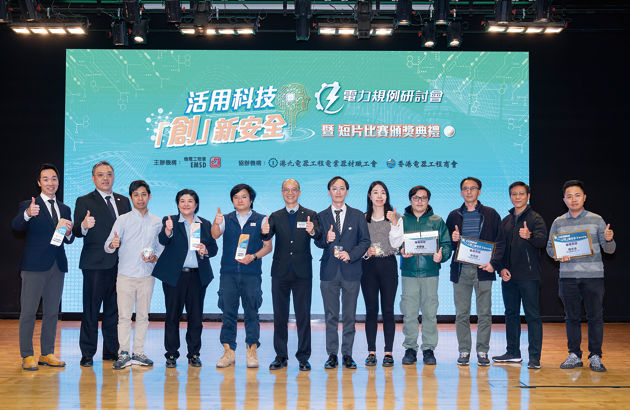
To promote the application of innovation and technology (I&T) and a safety culture among the electrical trade to enhance electrical safety, the EMSD also, in collaboration with the Union and the Association, organised the Short Film Competition on Innovative Technology for Electrical Safety in August 2024. Participants can make short videos to share how to use I&T to improve the working environment and raise electrical safety awareness for reference of practitioners. They can also incorporate in their entries innovative technologies that effectively enhance electrical work safety, such as smart devices, virtual reality and artificial intelligence analysis. The competition received an overwhelming response, with a large number of participants. The winning teams were invited to attend the Seminar this year, where their winning entries were shown.
In his opening speech at the Seminar, Mr CHAN Pak-cheung, Deputy Director/Regulatory Services of the EMSD, encouraged practitioners to make good use of I&T. He also stressed that the Government, businesses and workers should work together to enhance the professional standards and safety awareness of the electrical trade. On one hand, the Government supports and encourages the industry to create a better environment; on the other hand, the practical experience and innovative ideas of the electrical trade help refine policies.
| Topic | Speaker |
| Enhancing Electrical Safety Using Innovative Technologies | Ir Dr CHAN Fuk-cheung The Association |
| Smart Regulation via Innovation | Mr CHIU Sze-kit The EMSD |
| Electricity Supply to EV Charger Installations and Smart Meter Installation | Mr CHAN Chi-kin The CLP Power Hong Kong Limited (CLP Power) |
| Common Departures in Mock Up Inspection | Mr YEUNG Wai-hung The Hongkong Electric Company Limited (HEC) |
For more details of the Seminar and the competition, please visit the EMSD webpages:
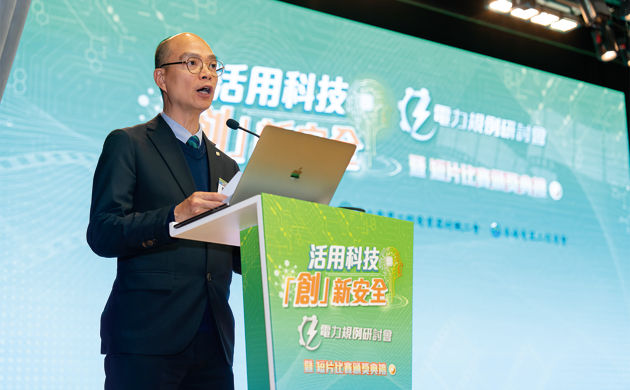
Mr CHAN Pak-cheung, Deputy Director/Regulatory Services of the EMSD, delivered the opening speech for the Seminar.
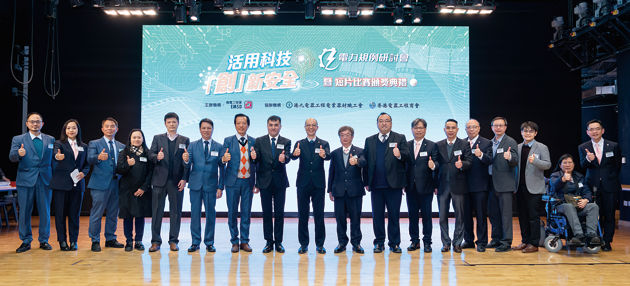
Mr CHAN Pak-cheung, Deputy Director/Regulatory Services of the EMSD (ninth left), Mr CHAU Wing-yee, Chairman of the Union (eighth left), and Mr CHOI Kan-man, President of the Association (ninth right),
took a group photo with the officiating guests.
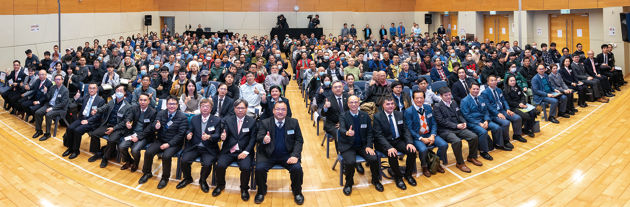
Group photo of all participants.
Mr CHAN Pak-cheung, Deputy Director/Regulatory Services of the EMSD (sixth left), presented prizes to the winners of the Short Film Competition on Innovative Technology for Electrical Safety.
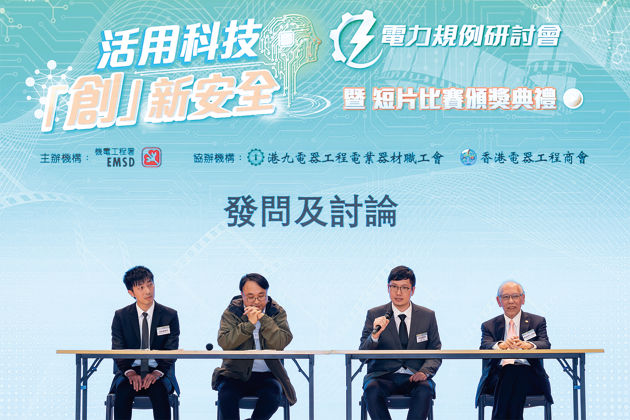
The speakers, (from left) Mr YEUNG Wai-hung, the representative of the HEC, Mr CHAN Chi-kin, the representative of the CLP Power, Mr CHIU Sze-kit, the representative of the EMSD, and Ir Dr CHAN Fuk-cheung, the representative of the Association, interacted with the participants.
(1) |
What is the main purpose of the Electrical and Mechanical Services Department's publication of the Code of Practice on Working near Electricity Supply Lines?
|
(2) |
How many task forces are there under the working group for the revision to the Code of Practice for the Electricity (Wiring) Regulations?
|
(3) |
What new facilities are available for public use after the renovation of the Registration and Permit Office?
|
|
|
(4) |
In respect of cross-border online purchase of household electrical products, which of the following may expose the public to safety risks?
|
|
|
(5) |
Which of the following places should a charging area not be set up in? |
|
We look forward to receiving your valuable feedback for continuous improvement so that the contents of Electricity News and the services of the EMSD can better meet your needs. Please complete the form and return it to the Electricity Legislation Division of the EMSD by post, fax or e-mail (please see the contact details at the bottom of this page) on or before 30 November 2025. Thank you.
Address: Electricity Legislation Division, EMSD, 3 Kai Shing Street, Kowloon, Hong Kong
Tel: 1823
Fax: 2895 4929
Email: info@emsd.gov.hk